Permittivity and Permeability of Materials Obstacle Course: Difference between revisions

From APL_wiki
Jump to navigation Jump to search
Bsboggs (talk | contribs)
Line 47: Line 47:


The measurements above for a lossless material amounts to requiring the permittivity to be real (as opposed to complex). However, for a lossy material, the permittivity is complex and we need an additional characteristic (beyond simply the capacitance) to characterize the material. This additional characteristic is the conductance <math>G</math>. The measurement below will include the conductance of the material.
<br><br><br><br><br><br><br><br><br><br>
<br><br><br><br><br><br><br>


=== * Permittivity of a ''Lossy'' Material From a Capacitance Measurement (up to 50 MHz)===

Revision as of 19:03, 21 May 2018

PAGE UNDER CONSTRUCTION


Permanent Materials

- 6061 3/8" Al rod stock
- Teflon
- Glass microscope slide
- HP Signal Generator (DC-1 GHz)
- Oscilloscope (at least 1GHz bandwidth)
- Miscellaneous electrical components

Materials to Borrow When Necessary

- Milling machine
- Lathe
- RF Lockin

Activities

Reading

  1. Read the Wikipedia articles on permittivity and permeability. With the help of the instructor or TA try to achieve a physical understanding of just what the permittivity and permeability mean in a bulk material.
  2. Read the first three sections of this paper (pages 1-27). Pay particular attention to the permittivity (Failed to parse (SVG (MathML can be enabled via browser plugin): Invalid response ("Math extension cannot connect to Restbase.") from server "https://wikimedia.org/api/rest_v1/":): {\displaystyle \epsilon} ) / capacitance and permeability (Failed to parse (SVG (MathML can be enabled via browser plugin): Invalid response ("Math extension cannot connect to Restbase.") from server "https://wikimedia.org/api/rest_v1/":): {\displaystyle \mu} ) / inductance associations.

Capacitance Techniques (Below 10MHz)

* Permittivity of a Lossless Material From a Capacitance Measurement

  1. Place three samples (air, Teflon, glass) between the aligned and polished ends of two 3/8" diameter, 1/2" lengths of 6061 Al rods (as shown at right). should be on the order of 1 mm. Measure the capacitances and, from the known surface area and spacing , determine the material's relative permittivity. (for a capacitor with no fringing fields).
  2. How do your measured permittivity values compare to standard reference values?
  3. Use this web applet to build a capacitor and observe the field lines . Are there fringing fields?

(air): 1.000536
(Teflon): 2.1
(glass): 3.7-10

* A Better Permittivity-Capacitance Measurement of a Lossless Material

  1. Use this web applet to build a guarded-electrode capacitor (as shown at the right) and observe the field lines . Are there fringing fields?
  2. Measure the three permittivities (air, Teflon, glass) again using this guarded-electrode setup.
  3. How do these results compare to your first (unguarded) measurements?
  4. How do these results compare to the standard values?


The measurements above for a lossless material amounts to requiring the permittivity to be real (as opposed to complex). However, for a lossy material, the permittivity is complex and we need an additional characteristic (beyond simply the capacitance) to characterize the material. This additional characteristic is the conductance . The measurement below will include the conductance of the material.


* Permittivity of a Lossy Material From a Capacitance Measurement (up to 50 MHz)

  1. Employ the guarded-electrode setup above and measure the lossy material's capacitance and conductance. and Failed to parse (SVG (MathML can be enabled via browser plugin): Invalid response ("Math extension cannot connect to Restbase.") from server "https://wikimedia.org/api/rest_v1/":): {\displaystyle G=\omega \epsilon^{''} \frac{A}{d}} , where Failed to parse (SVG (MathML can be enabled via browser plugin): Invalid response ("Math extension cannot connect to Restbase.") from server "https://wikimedia.org/api/rest_v1/":): {\displaystyle \epsilon^'\text{/}} Failed to parse (SVG (MathML can be enabled via browser plugin): Invalid response ("Math extension cannot connect to Restbase.") from server "https://wikimedia.org/api/rest_v1/":): {\displaystyle \epsilon^{''}} are, respectively, the real and imaginary parts of the complex permittivity.
    1. Simultaneously measure the voltage across the resistor Failed to parse (SVG (MathML can be enabled via browser plugin): Invalid response ("Math extension cannot connect to Restbase.") from server "https://wikimedia.org/api/rest_v1/":): {\displaystyle V_R} and Lock-in voltage Failed to parse (SVG (MathML can be enabled via browser plugin): Invalid response ("Math extension cannot connect to Restbase.") from server "https://wikimedia.org/api/rest_v1/":): {\displaystyle V_{Lock-in}} at Failed to parse (SVG (MathML can be enabled via browser plugin): Invalid response ("Math extension cannot connect to Restbase.") from server "https://wikimedia.org/api/rest_v1/":): {\displaystyle V_{out}} . Employ a lock-in time constant that is much longer than the period of the AC driving voltage. The lock-in voltage Failed to parse (SVG (MathML can be enabled via browser plugin): Invalid response ("Math extension cannot connect to Restbase.") from server "https://wikimedia.org/api/rest_v1/":): {\displaystyle V_{Lock-in}} is given by Failed to parse (SVG (MathML can be enabled via browser plugin): Invalid response ("Math extension cannot connect to Restbase.") from server "https://wikimedia.org/api/rest_v1/":): {\displaystyle V_{Lock-in}=\frac{1}{2}V_{out} \,\, cos(\theta)} , where Failed to parse (SVG (MathML can be enabled via browser plugin): Invalid response ("Math extension cannot connect to Restbase.") from server "https://wikimedia.org/api/rest_v1/":): {\displaystyle V_{out}} is the voltage across the capacitor and Failed to parse (SVG (MathML can be enabled via browser plugin): Invalid response ("Math extension cannot connect to Restbase.") from server "https://wikimedia.org/api/rest_v1/":): {\displaystyle \theta} is the phase difference between the AC driving voltage and Failed to parse (SVG (MathML can be enabled via browser plugin): Invalid response ("Math extension cannot connect to Restbase.") from server "https://wikimedia.org/api/rest_v1/":): {\displaystyle V_{out}}
    2. The current through the capacitor is given by Failed to parse (SVG (MathML can be enabled via browser plugin): Invalid response ("Math extension cannot connect to Restbase.") from server "https://wikimedia.org/api/rest_v1/":): {\displaystyle I_C=V_R/R} . The voltage across the capacitor is given by Failed to parse (SVG (MathML can be enabled via browser plugin): Invalid response ("Math extension cannot connect to Restbase.") from server "https://wikimedia.org/api/rest_v1/":): {\displaystyle V_{out}=Z_C I_C} , where Failed to parse (SVG (MathML can be enabled via browser plugin): Invalid response ("Math extension cannot connect to Restbase.") from server "https://wikimedia.org/api/rest_v1/":): {\displaystyle Z_C} is the capacitor's impedance. Solve for the impedance Failed to parse (SVG (MathML can be enabled via browser plugin): Invalid response ("Math extension cannot connect to Restbase.") from server "https://wikimedia.org/api/rest_v1/":): {\displaystyle Z_C} .
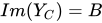
    3. The capacitor's admittance Failed to parse (SVG (MathML can be enabled via browser plugin): Invalid response ("Math extension cannot connect to Restbase.") from server "https://wikimedia.org/api/rest_v1/":): {\displaystyle Y_C} is given by Failed to parse (SVG (MathML can be enabled via browser plugin): Invalid response ("Math extension cannot connect to Restbase.") from server "https://wikimedia.org/api/rest_v1/":): {\displaystyle Y_C=\frac{1}{Z_C}} , where the Failed to parse (SVG (MathML can be enabled via browser plugin): Invalid response ("Math extension cannot connect to Restbase.") from server "https://wikimedia.org/api/rest_v1/":): {\displaystyle Re(Y_C)=G} (the conductance) and the Failed to parse (SVG (MathML can be enabled via browser plugin): Invalid response ("Math extension cannot connect to Restbase.") from server "https://wikimedia.org/api/rest_v1/":): {\displaystyle Im(Y_C)=B} (the susceptance). Calculate Failed to parse (SVG (MathML can be enabled via browser plugin): Invalid response ("Math extension cannot connect to Restbase.") from server "https://wikimedia.org/api/rest_v1/":): {\displaystyle G} .
    4. Read section 13.1 (pages 106-107) in this [paper].
    5. Calculate the relative permittivity Failed to parse (SVG (MathML can be enabled via browser plugin): Invalid response ("Math extension cannot connect to Restbase.") from server "https://wikimedia.org/api/rest_v1/":): {\displaystyle \epsilon_r} as Failed to parse (SVG (MathML can be enabled via browser plugin): Invalid response ("Math extension cannot connect to Restbase.") from server "https://wikimedia.org/api/rest_v1/":): {\displaystyle \epsilon'_r=\frac{C}{C_{air}}} and Failed to parse (SVG (MathML can be enabled via browser plugin): Invalid response ("Math extension cannot connect to Restbase.") from server "https://wikimedia.org/api/rest_v1/":): {\displaystyle \epsilon''_r=\frac{G}{\omega C_{air}}} .
    6. Do the above procedure for at least three frequencies between 10 MHz and 50 MHz.
    7. Plot Failed to parse (SVG (MathML can be enabled via browser plugin): Invalid response ("Math extension cannot connect to Restbase.") from server "https://wikimedia.org/api/rest_v1/":): {\displaystyle \epsilon'_r} and Failed to parse (SVG (MathML can be enabled via browser plugin): Invalid response ("Math extension cannot connect to Restbase.") from server "https://wikimedia.org/api/rest_v1/":): {\displaystyle \epsilon''_r} as a function of frequency.

Waveguide Techniques (above 50MHz)

coming soon...